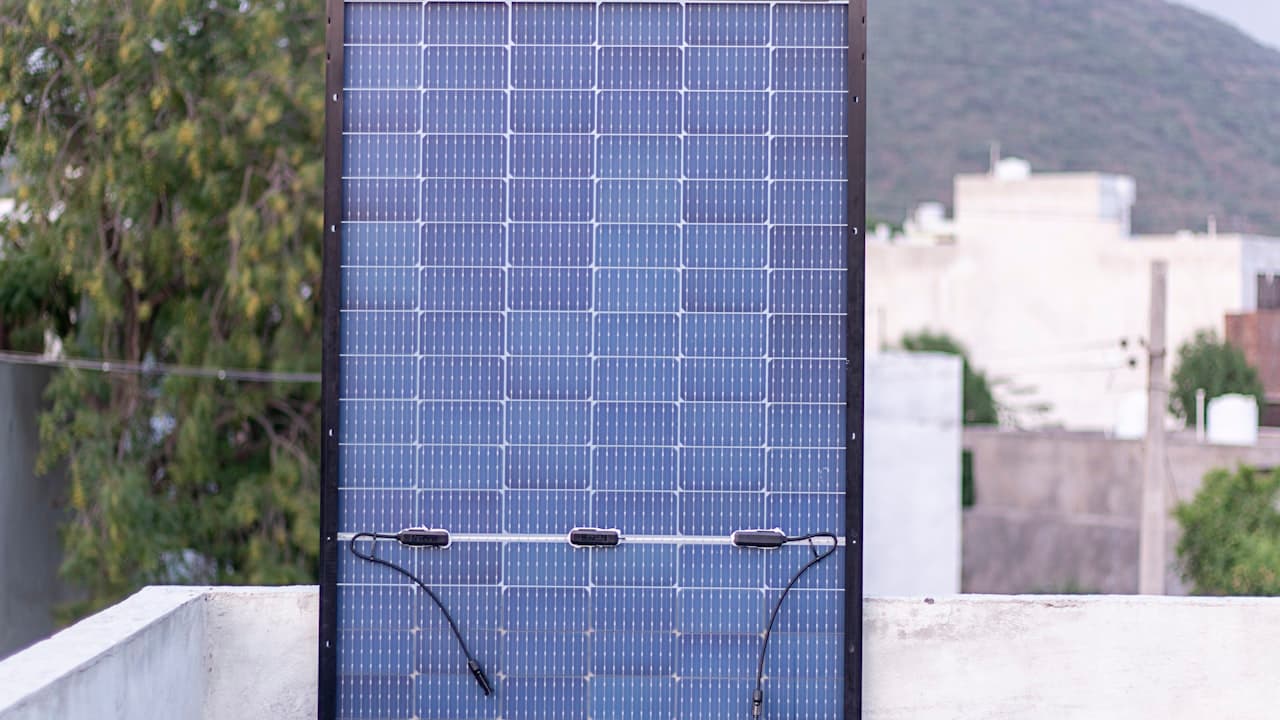
If you're shopping for solar panels in Zimbabwe, you'll notice that almost every installer quotes monocrystalline panels. Ten years ago, polycrystalline was the budget choice and mono was the premium option. That's no longer the case. Manufacturing costs have converged, and monocrystalline is now the standard for residential solar everywhere -- including Zimbabwe.
Here's why, and what you need to know to make a smart choice.
The Technology Tiers
Solar panel technologies fall into a clear hierarchy for residential use:
| Technology | Efficiency Range | Best For | Status |
|---|---|---|---|
| Mono PERC | 20-23% | Residential, commercial | Current standard |
| Mono (standard) | 18-20% | Residential, commercial | Being replaced by PERC |
| Polycrystalline | 15-18% | Budget installations | Declining market share |
| Thin Film | 10-13% | Large ground-mount farms | Not suitable for residential |
Mono PERC (Passivated Emitter and Rear Contact) is the current mainstream technology. It adds a reflective layer to the back of each cell, capturing light that passes through the first time. This bumps efficiency by 1-2% over standard monocrystalline -- a meaningful gain when you're working with limited roof space.
Most panels sold in Zimbabwe today are mono PERC, even if they're just labelled "monocrystalline" on the spec sheet. If the panel is rated above 20% efficiency and manufactured after 2022, it's almost certainly PERC.
Higher Efficiency = More Watts Per Square Metre
Efficiency is the percentage of sunlight that hits the panel surface and gets converted into electricity. The higher the number, the more power you get from the same physical area.
Here's what that means in practice for a standard residential panel footprint (~1.7m x 1.1m):
| Panel Type | Efficiency | Watts per Panel | Panels for 4kW System |
|---|---|---|---|
| Mono PERC | 21% | 550W | 8 panels |
| Polycrystalline | 16% | 420W | 10 panels |
| Thin Film | 12% | 315W | 13 panels |
Fewer panels means less roof space, less mounting hardware, less wiring, and faster installation. For homes with limited suitable roof area -- townhouses, cottages, or houses with partial shading -- higher efficiency isn't a luxury, it's a necessity.
If your roof is large and unobstructed, efficiency matters less. But most Zimbabwe homes don't have acres of perfect north-facing roof. Chimneys, water tanks, trees, and neighbouring buildings all create shading constraints. Mono PERC panels let you fit more generation capacity into the available space.
Better Performance in Heat
This is the factor that matters most in Zimbabwe, and it's the one most people overlook.
Solar panels get less efficient as they get hotter. The temperature coefficient tells you how much power output drops for every degree above 25 degrees C (the standard test temperature).
| Panel Type | Typical Temp Coefficient | Power Loss at 55 deg C |
|---|---|---|
| Mono PERC | -0.34%/deg C | ~10% loss |
| Polycrystalline | -0.40%/deg C | ~12% loss |
| Thin Film (CdTe) | -0.25%/deg C | ~7.5% loss |
On a hot October day in Harare, ambient temperature hits 35 degrees C, but your roof-mounted panels are sitting at 55-65 degrees C (the panel surface runs 20-30 degrees above ambient). At those temperatures, a mono PERC panel loses about 10% of its rated output. A poly panel loses 12%.
That 2% difference doesn't sound like much, but it compounds across every hot day of the year -- and Zimbabwe has a lot of hot days. Over the 8-9 months where daytime temperatures regularly exceed 25 degrees C, mono PERC panels deliver measurably more energy.
Thin film actually handles heat better than crystalline panels, but its low base efficiency means it still produces less total power per square metre. It only makes sense on massive ground-mount installations where space is unlimited -- not on residential rooftops.
Lower Degradation Over 25 Years
All solar panels lose a small amount of output each year as the silicon cells degrade. The degradation rate varies by technology:
- Mono PERC: 0.3-0.5% per year (retains ~87-92% of original output after 25 years)
- Polycrystalline: 0.5-0.7% per year (retains ~82-87% after 25 years)
The difference over a 25-year system life is significant. A 550W mono PERC panel producing at 90% of its original rating after 25 years still generates 495W. A 420W poly panel at 85% produces 357W -- that's a 28% gap in absolute output.
Manufacturers back this with their warranty terms. Most tier-1 mono PERC panels carry:
- Product warranty: 12-15 years (against manufacturing defects)
- Performance warranty: 25-30 years (guaranteeing at least 80-84.8% of rated output)
The Price Gap Has Narrowed
Five years ago, monocrystalline panels cost 15-25% more than polycrystalline. That premium has nearly vanished. As of 2026:
- A 550W mono PERC panel typically costs $120-$180 in Zimbabwe
- A 330W poly panel costs $70-$100
On a per-watt basis, mono PERC costs roughly $0.22-$0.33/W versus poly at $0.21-$0.30/W. The difference is negligible -- and mono gives you more watts per panel, better heat performance, and slower degradation.
There's no longer a compelling cost reason to choose polycrystalline for a new installation.
Be cautious with suspiciously cheap panels from unknown brands. Counterfeit and substandard panels are a real problem in Zimbabwe. Always verify the manufacturer and check for IEC 61215 (performance) and IEC 61730 (safety) certification marks.
Verify Equipment
Check if your solar equipment is genuine and certified.
Bifacial Panels: Capturing Light From Both Sides
A relatively new option gaining traction is bifacial mono PERC panels. These have a transparent back sheet instead of an opaque one, allowing them to capture reflected light from the ground or roof surface below.
The gain depends on what's beneath the panels:
- White or light-coloured surface: 10-15% extra output
- Bare concrete or gravel: 5-8% extra output
- Dark roof tiles or grass: 2-4% extra output
For ground-mounted systems or light-coloured roofs, bifacial panels offer a meaningful boost for a modest price premium. For dark-tiled rooftops, the gain is small and probably not worth the extra cost.
Half-Cut Cells: Better Reliability
Most modern mono PERC panels use half-cut cell technology. Instead of 60 or 72 full-size cells, the panel has 120 or 144 half-size cells.
Why does this matter?
- Lower electrical resistance -- half-cut cells carry less current, reducing power losses as heat
- Better shade tolerance -- if one section of the panel is shaded, only that section's output drops; the rest keeps producing
- Reduced hot-spot risk -- hot spots form when a shaded cell becomes a resistive load; smaller cells mean less concentrated heat
Hot spots are a genuine concern in Zimbabwe where bird droppings, dust, and tree debris can partially shade panels. A hot spot on a full-size cell can damage the panel permanently. Half-cut cells are more forgiving.
What About Thin Film?
Thin film panels (CdTe, CIGS, amorphous silicon) occasionally come up in conversations. They have some advantages -- excellent heat tolerance, better performance in low light, and a sleek appearance. But for residential rooftops in Zimbabwe, they don't make sense:
- Low efficiency (10-13%) means you need roughly double the roof space for the same output
- Larger mounting area means more racking, more labour, more cost
- Limited availability in Zimbabwe -- almost no local suppliers carry residential thin-film
- Designed for utility-scale ground-mount installations where land is cheap and space isn't a constraint
Unless you're building a solar farm on open land, stick with mono PERC.
What to Look for When Buying Panels
Here's a checklist for evaluating panels:
- Technology: Mono PERC (labelled as PERC, half-cut, or M10/G12 cell size)
- Wattage: 540-580W is the current sweet spot for residential panels
- Efficiency: 20% or higher
- Temperature coefficient: -0.35%/deg C or better (lower magnitude is better)
- Product warranty: 12 years minimum
- Performance warranty: 25 years with at least 84% guaranteed output
- Certifications: IEC 61215, IEC 61730
- Tier-1 rating: Bloomberg New Energy Finance tier-1 listing indicates bankable quality
Use the SolMate equipment lookup to search the CEC database for certified panels, compare specs side by side, and check compatibility with your inverter's voltage range.
Equipment Lookup
Browse and compare certified solar equipment.
The Bottom Line
Monocrystalline PERC panels are the right choice for almost every residential installation in Zimbabwe. They deliver more power per square metre, handle the heat better, degrade more slowly, and cost almost the same as polycrystalline. The technology has matured to the point where there's no meaningful trade-off -- mono PERC wins on efficiency, durability, and value.
When your installer quotes you panels, make sure they're mono PERC with half-cut cells, rated above 20% efficiency, and certified to IEC 61215 and 61730. That's the baseline for a system you can trust for 25 years.